
By Bob Atwiine
Zimbabwe – Zimbabwe’s fisheries and aquaculture sector recorded a remarkable 64.68% increase in farmed fish production in 2025 surging from 4,986 metric tonnes to 8,211 metric tonnes, according to the newly released 2025 Annual Report from the Fisheries and Aquaculture Resources Production Department (FARD).
The dramatic growth was fueled primarily by the Presidential Community Fisheries Scheme, a flagship government initiative that added 4,611 new ponds nationwide and propelled pond culture production upwards by 46.2%.
The scheme designed to enhance food security and rural livelihoods has become the cornerstone of Zimbabwe’s ambitious plan to build a US$1 billion fisheries economy by 2030.
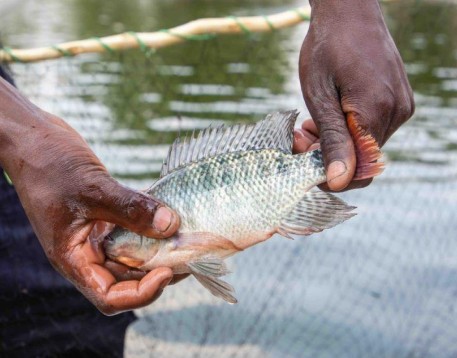
According to the report, Nile tilapia continued its reign as the sector’s undisputed leader accounting for over 90% of farmed fish and recording a 62.81% production increase to 7,815 metric tonnes.
However, the year’s most striking growth came from African catfish which more than doubled its output rising 139.57% from 139 to 333 metric tonnes.
“Catfish farming represents a game-changer for Zimbabwe,” said Milton Tinashe Makumbe, Director of FARD, during a tour of the Zimbabwe Catfish Growers site in Gletwyn, Harare adding that “They thrive in areas with limited water supply, require relatively low initial investment and reach market size in just six months. This makes them a profitable option for small-scale farmers.”
Trout production also showed signs of recovery increasing 50% from 30 to 45 metric tonnes though the sector continues to struggle with high feed costs, environmental pressures and competition from imports.
The government has pledged to increase trout production to 200 metric tonnes annually.
The report also highlights that total fingerling production for 2025 reached 33.09 million with Nile tilapia fingerlings comprising 32.27 million of that total.
Private hatcheries dominated supply accounting for 60.2% of the fingerlings used in the sector. Lake Harvest emerged as the single largest producer contributing 25.83 million fingerlings.
However, the report warns that national demand currently sits at 39.1 million fingerlings creating a strategic gap that represents both a challenge and an opportunity for investment.
Government hatcheries accounted for only 1.7% of total production underscoring the need for revitalization of public breeding infrastructure.
In a landmark move, Zimbabwe launched its National Fish Hatchery Management Guidelines on November 19, 2025, in Bulawayo.
The guidelines developed in collaboration with the Food and Agriculture Organization (FAO) aim to standardize hatchery operations, improve genetic quality and address concerns that nearly 40% of fingerlings currently originate from unregulated sources.
Deputy Minister of Lands, Agriculture, Fisheries, Water and Rural Development, Hon. Davis Marapira who officiated at the launch emphasized the guidelines as a national standard for quality seed production.”
The initiative coincides with the revitalization of government Fish Breeding Units at Henderson, Makoholi and Matopos which received high-quality tilapia brood stock through an FAO Technical Cooperation Programme.
From Sex Workers to Fish Farmers
Perhaps the most compelling Zimbawe’s story in the 2025 report is the human transformation occurring at the community level.
The Pamodzi Fisheries group in Goromonzi District supported under the Presidential Community Fisheries Scheme has become a beacon of empowerment.
The cooperative whose members include former sex workers and teenage mothers harvested its first batch of tilapia in May 2025 and has since restocked for a second cycle, the report says.
“These women are not just growing fish, they are growing their own futures,” said Director Makumbe during a site visit.
Similarly, the Fish4Schools programme at Chinorumba Primary School in Zaka District has proven aquaculture can be a powerful educational tool.
The School Business Unit stocked with 2,000 fingerlings generated income for school development while providing hands-on practical learning. Schools Inspector Fusirai noted the project had improved attendance and boosted Grade 7 pass rates.
Regulatory Reform
The report further shows that a stakeholder consultations for Zimbabwe’s first comprehensive Fisheries and Aquaculture Bill concluded in 2025 with the legislation expected to streamline governance and reduce compliance costs.
The bill consolidates all existing fisheries regulations into a single framework and proposes significant investment incentives including VAT exemptions on fish sales duty waivers on imported aquaculture equipment and reduced Lake Lease fees.
The bill also addresses longstanding challenges such as weak enforcement against Illegal, Unreported and Unregulated (IUU) fishing and limited access to credit. Draft provisions include quotas for women (40%) and youth (30%) in agricultural lending schemes.
Lake Kariba Joint Blue Economy Strategy
Zimbabwe and Zambia validated the draft Joint Blue Economy Strategy and Investment Plan for Lake Kariba in 2025 under the PROFISHBLUE Project, the report reveals.
The plan identifies governance, climate resilience, fishery co-viability and transversal supporting initiatives as priority investment areas for Africa’s largest man-made lake.
The SADC Secretariat also handed over a refrigerated truck to the Zimbabwe Fish Producers Association, strengthening cold chain infrastructure to reduce post-harvest losses and improve market access for small-scale fishers.
Despite notable achievements, the report highlights persistent challenges. High feed costs remain the dominant operational expense, accounting for 60-70% of total production costs.
Climate change impacts including receding lake levels continue to threaten capture fisheries.
Per capita fish consumption remains low at approximately 3.2 kg, well below the SADC regional average.
Nevertheless, with strong policy direction and stakeholder collaboration, Zimbabwe is positioning its fisheries and aquaculture sector as a key driver of food security, rural employment and economic growth.
Current projections estimate total fish production for 2025 at 35,151 metric tonnes, valued at US$49.3 million.