
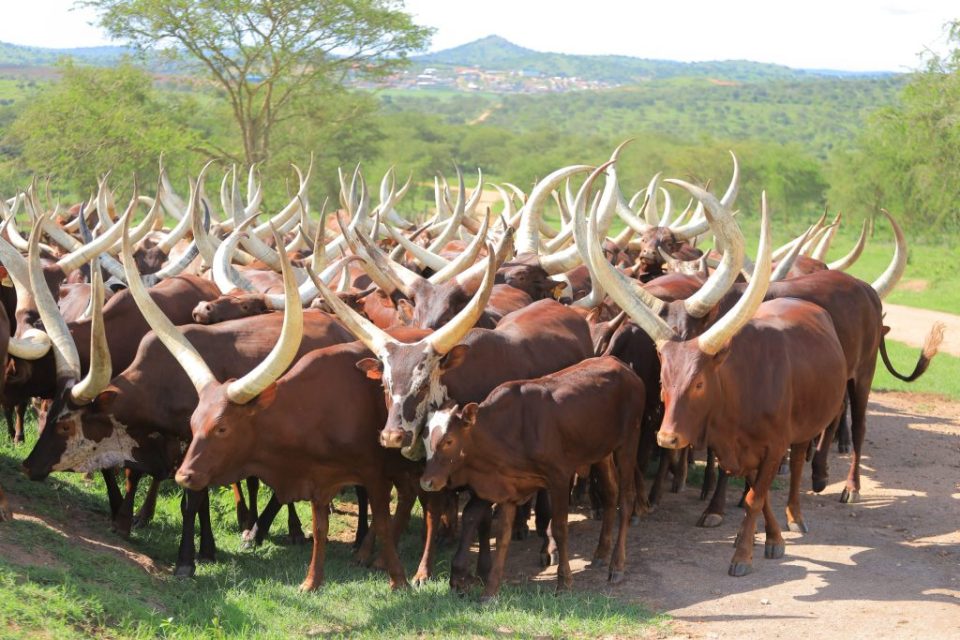
KIRUHURA- Uganda’s iconic Ankole Longhorn is taking on a new dimension at Nshaara Conservation Ranch where the National Animal Genetic Resources Centre and Data Bank (NAGRC&DB) is using systematic genetic selection, pedigree management performance recording and improved nutrition to develop a high-milk-yielding pure Ankole dairy population without replacing the breed with exotic dairy genetics.
Approximately three years ago, NAGRC&DB initiated a deliberate programme to
identify superior pure Ankole cattle with greater milk-production potential at Nshaara
Conservation Ranch in Kiruhura district.
The programme involved screening animals
within the available population and incorporating selected superior Ankole genetics from other recognised sources, including the Kisozi Ankole Longhorn conservation and improvement herd.
The intention was not to crossbreed or replace the indigenous Ankole with exotic dairy genetics but to exploit the natural genetic variation that already exists within the breed and progressively concentrate desirable dairy traits through selection.
The programme began by establishing clear selection criteria for the nucleus
population.
Milk yield was prioritised as the principal productive trait, followed by lactation length udder conformation and calving interval.
This allowed the ranch to identify cows that combined relatively high milk output with sustained lactation and reproductive efficiency.
Replacement heifers were subsequently evaluated using information on their dams’ milk production, growth and fertility to get her with physical assessment of body structure udder characteristics and temperament.
As superior female lines became identifiable, the programme increasingly focused on the selection of breeding bulls from high-performing maternal families.
Because genetic improvement of milk production can be transmitted through sires to their daughters, candidate bulls are selected partly on the milk-production performance of their dams.
This is complemented by assessment of growth rate, body size and stature, age at maturity, reproductive soundness, testicular development, libido, temperament and ot her functional characteristics.
Bulls originating from highly productive cows are consequently prioritised to advance the milk-production trait within subsequent generations.
According to Dr. Innocent Tuwangye, Manager of Nshaara Conservation Ranch, ,the approach is centred on improving the Ankole from within its own genetic population.
“We are not trying to turn the Ankole into an exotic dairy cow. We are identifying
Superior dairy traits that already exist within the pure Ankole population and
systematically selecting and multiplying those genetics.
The objective is to develop an Ankole animal that produces more milk while retaining the adaptability, resilience and genetic identity for which the breed is known,” he said.
The production records are complemented by information on reproductive events
and animal health.
These data are maintained in physical farm records and in NAGRC&DB’s Integrated Livestock Management Information System (ILMIS) allowing the breeding team to progressively build individual performance histories and link production outcomes to particular animals and maternal lines.
Historical performance, including peak yields across successive la ctat ions, is then used to inform sub sequent selection decisions.
By 2023, the programme had generated sufficient production records to begin
demonstrating measurable performance at herd level.
Average recorded milk productivity stood at 5.2 litres per active cow-day, with annual recorded production of approximately 56,040 litres.
The active milking population increased from 24 cows in January to 35 cows by December of that year.
Selection, performance recording and herd management continued into 2024.
Average productivity subsequently increased to 7.0 litres per cow per day, while
annual recorded milk production rose to approximately 106,358 litres.
The milking population also expanded from 36 cows at the beginning of the year to 47 cows by December.
By December-2025, average productivity had risen further to 8.6 litres per cow per
day while annual recorded production reached approximately 168,285 litres.
The milking population expanded from 47 cows in January to 60 cows by December.
Taken together, the records indicate an approximately 65.4 percent in crease in
average productivity between 2023 and 2025, alongside a progressive expansion of
the selected milking population.
At individual-animal level, the improvement has been equally encouraging. Whereas
an Ankole cow under the traditional production conditions produces averagely 2 litres during morning milking, selected cows in the programme are now regularly recording approximately 5-10 litres from a single morning milking session with a few
exceptions that produce up to 12 litres between the second and seventh lactations.
The emerging results also demonstrated that genet ic potential alone was insufficient
to sustain higher production.
NAGRC&DB therefore strengthened nutritional management by supplementing convention al grazing with hay and silage produced at Nshaara.
The highest individual yields were observed under this improved feeding
regime, providing an important practical link between genetic improvement and
adequate nutrition.
“Our records are increasingly showing us that breeding and feeding must move
together”Dr. Peter Beine- the Executive Director NAGRC&DB explained.
Selection identifies the animal with superior genetic potential, but nutrition determines how effectively that potential is expressed.
We are therefore using the production data
not only to select our breeding animals but also to refine feeding and management
protocols for the emerging Ankole dairy population.
“The programme is now entering an important phase in which the emphasis shifts from identifying a few exceptional animals to consolidating superior performance across families and successive generations. An individual cow attaining a peak morning yield of 14 litres demon strates the productive potential present within the Ankole population, but the longer-term breeding objective is to make superior performance increasingly repeatable, herit able and predictable.
This will require continued pedigree recording, identification of elite cows, selection of replacement heifers from proven maternal lines, use of bulls originating from superior dams and
systematic evaluation of the resulting progeny.
“Our real measure of success will not simply be one eXceptional co,”Dr. Peter
Beine said.
“The breeding objective is to establish a population in which superior
milk production can be consistently reproduced from one generation to another.
That is why pedigree integrity, individual animal identification, performance
recording and selection of proven naternal and sire lines are central to what we are
doing at Nshaara.”
What began at Nshaara asthe identification of naturally super ior milk-producing
Ankole cows is stea dily developing into a structured breeding programme aimed at
producing a genetically stable, productive and resilient pure Ankole dairy population
placing Uganda’s own indigenous cattle genetics at the centre of the country’s future
livestock productivity agenda.